Sticky Blood: The Ultimate Creepy Display Font
What Is Sticky Blood?
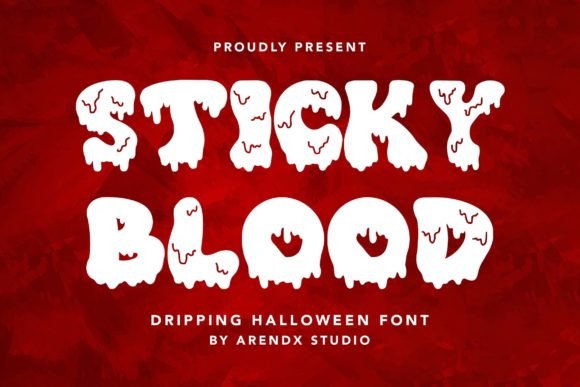
Sticky Blood is a bold, dripping display font that channels raw horror energy—think fresh wounds, midnight rituals, and abandoned asylums. With its uneven baselines, viscous serifs, and intentionally unstable letterforms, this Display font doesn’t just sit on the page—it oozes across it. Designed for maximum atmospheric impact, Sticky Blood stands out in a crowded field of Halloween fonts by balancing grotesque detail with surprising legibility at large sizes. If you’re looking for a high-impact, mood-driven typeface for seasonal or niche branding, Sticky Blood delivers—and yes, you can find a Sticky Blood free download via select platforms (more on licensing below). Unlike generic “scary” fonts, Sticky Blood earns its place among premium Display fonts through deliberate craftsmanship and consistent tonal control.
Letterforms: Organic Distortion, Not Random Chaos
Each glyph in Sticky Blood features subtle asymmetry—slight tilts, irregular ink traps, and simulated “drip trails” that vary per character. This isn’t algorithmic noise; it’s hand-guided imperfection. That intentional variation makes it feel alive, not templated—a key differentiator from cheaper alternatives.
Weight & Contrast: Heavy but Breathable
Sticky Blood sits firmly in the bold-to-black weight range, yet avoids visual suffocation thanks to open counters and generous internal spacing. Its contrast is moderate—not razor-thin like a Didone, nor monoline like a geometric sans—making it more versatile than many Display fonts that sacrifice readability for drama.
Spacing & Kerning: Built for Impact, Not Body Text
This is strictly a Display font. Tight default tracking enhances cohesion in headlines, but manual kerning is recommended for logos or short phrases. Never use it below 36pt for print or 48px for web—its personality collapses at small sizes.
Sticky Blood for logo design
When your brand lives in the gothic, alternative, or experiential space—haunted attractions, metal bands, indie horror games—Sticky Blood conveys tone instantly. It works best when paired with minimal supporting elements: no gradients, no shadows, just stark color contrast (black on blood-red, white on charcoal).
Sticky Blood for branding
For limited-run merchandise, event identities, or seasonal campaigns, Sticky Blood adds instant narrative weight. Think: a pop-up “Curse Night” bar series or a vinyl reissue campaign for a cult horror soundtrack. Just remember—branding demands consistency, so test how it scales across app icons, social avatars, and merch tags.
Sticky Blood for posters and social media
This is where Sticky Blood shines brightest. Its visceral texture translates powerfully to Instagram carousels, Spotify playlist covers, and A2 concert posters. For social media, pair it with tight line-heights and generous padding—let the font breathe, then let it bleed.
Sticky Blood for packaging
Craft beer labels, limited-edition candles (“Midnight Grave Soil”), or collectible trading cards benefit from Sticky Blood’s tactile presence. Use spot UV or embossing to enhance the “wet” illusion—but always test mockups under real lighting. What looks convincingly gory on screen may read as muddy on matte kraft paper.
Font Pairing & Combinations
Sticky Blood demands contrast. Its intensity overwhelms most companions, so pairing requires restraint. What fonts pair well with Sticky Blood? Start with clean, neutral sans-serifs like Inter or Montserrat Light for body text—no frills, no competition. For editorial layouts, try a sturdy serif like Crimson Text or PT Serif for captions and pull quotes. One unexpected winner? A restrained script like Sancreek or Parisienne at small sizes—its delicate flow creates elegant tension against Sticky Blood’s aggression. That’s the core of smart Sticky Blood font pairing: balance, not harmony.
Licensing & Commercial Use
Here’s the critical question: is Sticky Blood free for commercial use? The answer depends entirely on your source. Some free font sites offer Sticky Blood under SIL Open Font License (OFL), permitting personal and commercial use with attribution. Others host cracked or modified versions with no license clarity—avoid those. Always verify the Sticky Blood font license before deploying in client work. For guaranteed rights, consider purchasing the official version, which often includes extended licenses for app embedding, merchandise resale, and broadcast use. That makes Sticky Blood a true professional Fonts font, not just a freebie.
How to Download & Use Sticky Blood
You’ll find a legitimate download Sticky Blood font free option on reputable platforms like CreativeFabrica (often bundled with Halloween-themed assets) or FontSquirrel (if licensed under OFL). DaFont hosts it too—but double-check the license badge before downloading. Once installed, using Sticky Blood is straightforward: activate it in Photoshop via the Character panel, load it into Canva’s “Uploads” tab, or install it system-wide for Word and Illustrator. How to use Sticky Blood in Canva/Word/Photoshop? In Canva, upload the .ttf file first—then apply it to headings only. In Word, it appears like any system font, but avoid auto-hyphenation or justification. In Photoshop, rasterize only if exporting static PNGs; keep live text layers editable for revisions.
Designer Notes & Tips
Test Sticky Blood in black-and-white first. Color can mask poor spacing or weak contrast—especially red-on-black, which risks optical vibration. Also, check readability at intended sizes: what reads as “sinister” at 120pt may become indecipherable at 24pt on mobile. And when considering alternatives, ask yourself: Sticky Blood vs similar font—like Blood Lust or Horrorshow—isn’t about which is “better,” but which serves your story. Blood Lust leans cartoonish; Horrorshow feels dated. Sticky Blood lands in the uncanny valley between realism and stylization—making it the most adaptable premium Display font for contemporary horror-adjacent projects. Whether you need a free Display font for Fonts experimentation or a licensed asset for client deliverables, Sticky Blood earns its place—not as a gimmick, but as a considered typographic tool.